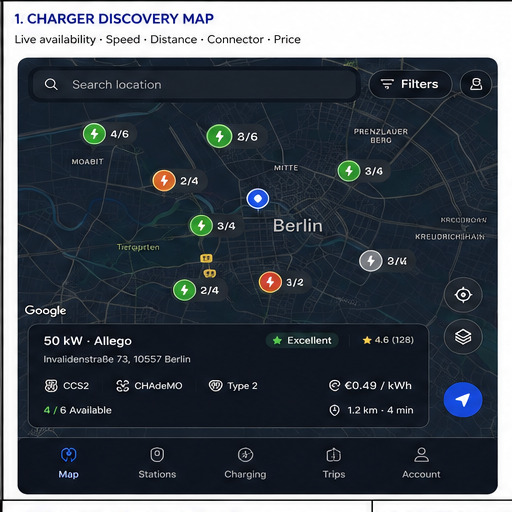
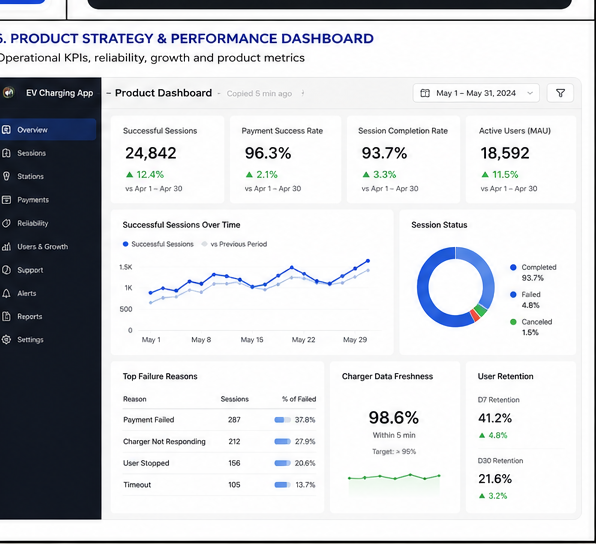
From fragmented charging journeys to a trusted, interoperable and measurable product system. The opportunity is not another charger map. It is a charging-confidence layer that makes availability, compatibility, price, payment and failure recovery trustworthy enough to complete a session.
“
Reliability is the feature.
Trust comes before growth.
A controlled pilot is recommended only after availability, station-detail and payment integrations pass technical gates.
Type
Self-directed senior product case
Context
MBA Mobility FHM Berlin
Evidence
36 modelled journey scenarios
Decision
Conditional go controlled pilot
Independent portfolio case study. Proposed targets are not live product results.PROJECT 09 | 1/10
01
The problem
Public charging fails as a chain, not as a single screen.
A driver sees one app, but the outcome depends on station data, roaming, connector compatibility, authentication, payment, charger hardware, vehicle communication and support. A weak link anywhere becomes a failed customer journey.
Stale availability
A station appears free but is occupied, offline or out of service. The system must expose data age and confidence.
Connector mismatch
The driver arrives at a connector or power level that does not fit the vehicle or trip need.
Price surprise
Tariffs, roaming fees, time charges or occupancy fees are incomplete before the session starts.
Payment failure
Authorisation, token, network or settlement failures stop an otherwise valid charging attempt.
Session ambiguity
The charger, app and backend disagree about whether energy is flowing, stopped or completed.
Weak recovery
When a session fails, the user receives no clear diagnosis, retry path, alternative charger or accountable support owner.
STRATEGIC REFRAMING
The first product is a reliable data and transaction contract across the charging ecosystem.
36 modelled scenarios are used as product-discovery evidence, not production analytics.PROJECT 09 | 2/10
02
The vision
Make every charging decision feel dependable.
The platform should not optimise for app opens or the number of pins on a map. It should help a driver find a usable station, understand the full price, start energy transfer, complete the session and recover quickly when something breaks.
SIX TRUST CONTRACTS
Availability trust
Show status age, source timestamp, expected arrival state and a fallback location.
Compatibility trust
Match connector, power, vehicle profile, cable requirement and access constraints.
Price trust
Show energy, time, session, occupancy and roaming components before start.
Acknowledge start, energy flow, progress, stop state and the final charge-detail record.
Recovery trust
Retry automatically, explain in plain language, suggest alternatives and escalate to support.
POSITIONING
One evidence-based charging path that ranks stations by confidence, shows complete price and compatibility, completes payment, monitors the session and recovers failures. Unlike a generic map, it is measured by successful sessions.
North star: successful charging sessions per active user.PROJECT 09 | 3/10
03
The solution
A charging-confidence system, not a feature catalogue.
The MVP connects discovery, compatibility, transparent price, unified payment, active-session status and rapid recovery. It deliberately excludes reservation, deep OEM integration, fleets and V2G until the core journey proves reliable.
DRIVER EXPERIENCE
Map, station details, price, compatibility, payment and session
OPERATIONS VIEW
Network health, freshness, failed starts, incidents and recovery
SMALLEST END-TO-END OUTCOME
01
Find a usable station
02
Choose with confidence
03
Authorise and pay
04
Start energy flow
05
Monitor the session
06
Recover or finish
MVP rule: solve the smallest complete charging outcome, not the largest number of screens.PROJECT 09 | 4/10
04
Customer journey and service blueprint
The customer journey and backstage operations must close the same outcome.
Every visible step needs a matching data, transaction and recovery capability. The product is successful only when the frontstage promise and the backstage system remain consistent.
01
Plan
Frontstage
Search by destination, time and battery need.
Backstage + Measure
Query station, vehicle and tariff data; calculate confidence. Freshness and station-detail accuracy.
02
Choose
Frontstage
Compare compatible stations, expected availability and full price.
Backstage + Measure
Rank by trust before commercial preference. Search-to-selection and ranking integrity.
03
Arrive
Frontstage
Confirm stall, connector and fallback option.
Backstage + Measure
Refresh status, detect material change and trigger alternative. Arrival mismatch rate.
04
Authorise
Frontstage
Pay ad hoc or use an account token.
Backstage + Measure
Validate payment, roaming token and session intent. Payment authorisation success.
05
Start
Frontstage
Receive acknowledgement and energy-flow status.
Backstage + Measure
Run the session state machine and retry safely. Charge-start success and start time.
06
Charge
Frontstage
Track energy, estimated cost and exceptions.
Backstage + Measure
Reconcile charger events, session state and tariff calculation. Session completion and state consistency.
07
Finish
Frontstage
Stop, receive a receipt and report an issue.
Backstage + Measure
Reconcile CDR, capture payment and process refunds. Charge-end success and receipt latency.
08
Recover
Frontstage
Retry, switch charger or contact support.
Backstage + Measure
Diagnose automatically, assign incident owner and enforce SLA. Median recovery time and unresolved rate.
Service quality is an end-to-end property: discovery, transaction, execution and recovery must agree.PROJECT 09 | 5/10
05
Architecture and interoperability
Protocols enable interoperability. The product still owns the outcome.
The application integrates with operators and partners; it does not directly control every charge point. A canonical product model keeps partner-specific logic out of the customer experience.
ExperienceDriver app, web account and operator portal
Decision servicesDiscovery, confidence score, routing, payment, session manager and recovery
Data and intelligenceStation data, compatibility, reliability signals, observability and analytics
Platform foundationCloud, security, privacy, monitoring, tracing and scalable data processing
DESIGN RULEExternal protocols enable interoperability; the product layer owns trust, ranking, recovery and the end-to-end outcome.
PROTOCOL AND POLICY BOUNDARIES
OCPI
Versioned contracts for locations, tariffs, tokens, sessions and charge-detail records.
OCPP
Backend and charge-point communication; the app consumes normalised operator events.
ISO 15118
Secure vehicle-charger communication and future Plug & Charge authentication.
AFIR
Ad hoc payment and clear pre-session pricing are product requirements, not optional polish.
EU Data Act
Consent, user access, third-party sharing and retention require product governance.
Conceptual architecture based on public standards; no confidential operator or OEM systems are claimed.PROJECT 09 | 6/10
06
Confidence, reliability and measurement
Uptime is necessary. First-time charging success is the customer outcome.
A station can be technically online and still fail the customer. The measurement system therefore connects freshness, compatibility, payment, energy flow, recovery and reconciliation.
STATION CONFIDENCE SCORE
Rank by evidence before proximity or promotion.
FreshnessHow recent and stable is the availability signal?
CompatibilityWill this connector, power and access model fit the vehicle?
ReliabilityHow often do authorised attempts reach energy flow?
Price completenessAre all tariff components known before start?
Recovery readinessIs there a viable fallback and support path?
PROPOSED PILOT GUARDRAILS
Availability freshness≥95% of displayed statuses updated within 2 minutes
Station-detail accuracy≥97% match for connector, power and access
Session completion≥85% for eligible app-started sessions
Support recoveryMedian <5 minutes to a viable next action
Receipt reconciliation≥99% within stated latency
NORTH STAR
Successful charging sessions per active userGrowth metrics sit below reliability guardrails. Searches, clicks and downloads do not count as completed value.
All thresholds are proposed pilot gates and require calibration against real partner baselines.PROJECT 09 | 7/10
07
MVP, trade-offs and evidence gates
Build the riskiest evidence before the most expensive feature.
The first release proves that the system can show accurate station information, complete a payment, start energy flow and recover failure. Features that create new dependency risk remain outside the initial launch.
CORE MVP
Map discovery and station details
Vehicle compatibility and full price
Unified payment and duplicate prevention
Active-session status and stop control
Rapid recovery and fallback charger
LATER, AFTER EVIDENCE
Reservation and enforceable slots
Deep OEM battery and route integration
Fleet controls and consolidated billing
Plug & Charge at supported networks
Partner offers that preserve ranking integrity
EXPLICIT NON-GOALS
Nationwide launch before reliability proof
Advertising that overrides trust ranking
V2G before core transaction stability
Community features before failure recovery
Guaranteed reservation without operator enforcement
EVIDENCE SEQUENCE
E1
Data contracts
Freshness ≥95%; station match ≥97%
E2
Payment sandbox
Success ≥98%; no duplicate capture
E3
Journey usability
Users identify compatibility, price and urgency
E4
Silent pilot
Measure baseline without recommendations
E5
Controlled pilot
More successful sessions without support overload
E6
Reservation test
Lower uncertainty without utilisation loss
Decision after every gate: scale, redesign, defer or stop.PROJECT 09 | 8/10
The roadmap is not a calendar promise. Each phase unlocks only when technical, customer and operating evidence passes the gate.
0-3 MONTHS
Trust foundation
Data contracts, payment sandbox, observability and baseline.
4-6 MONTHS
Core utility
Controlled pilot, station-confidence ranking and recovery.
7-9 MONTHS
Retention proof
Repeat use, reliability improvements and support learning.
10-12 MONTHS
Platform proof
Partner APIs, later-phase features and scale/stop decision.
ECONOMIC RULE
Optimise contribution per successful session - never revenue per search.
Illustrative value sources include a small fee on completed sessions, an optional premium layer and later fleet pilots. Core reliability stays free, failed sessions create no fee, and commercial placement cannot override the trust ranking.
TOP RISKS AND OWNERSHIP
False confidence
Freshness SLO, confidence downgrade and partner audit.
Integration lead
Payment/session mismatch
Idempotency, reconciliation and event trace.
Payments lead
Commercial ranking conflict
Trust floor and zero override metric.
Product manager
Support overload
Automated diagnosis, pilot limits and recovery SLA.
Operations lead
Governance covers consent, data minimisation, access, retention, deletion and security incident ownership.PROJECT 09 | 9/10
09
Impact and final recommendation
Conditional go. Reliability before acquisition.
Launch a limited metropolitan pilot only after availability, station-detail and payment integrations pass technical gates. Measure completed charging value, not only engagement. Pause acquisition when reliability misses target for two consecutive cohorts.
PROVE FIRST
Availability freshness, station accuracy, payment reliability and charge-start success.
SCALE WHEN
Successful sessions improve without complaint volume, support overload or ranking distortion.
REDESIGN WHEN
Drivers cannot understand compatibility, price, urgency or recovery actions.
STOP WHEN
The ecosystem cannot provide sufficiently fresh, enforceable or reconcilable data.
WHAT THIS PROJECT DEMONSTRATES
System-level product strategy
Reframes the problem from charger discovery to reliable session completion.
Decision-system design
Connects data, transaction logic, recovery and measurable evidence gates.
Interoperability thinking
Translates AFIR, OCPI, OCPP and ISO 15118 into product responsibilities.
Responsible scaling
Uses reliability guardrails, controlled experiments, economics and governance before growth.
Independent case study 36 modelled scenarios|Proposed pilot gates|No confidential operator or OEM data|Results are not claimed as live outcomes
Go beyond the overview. Explore the complete project documentation, process, and supporting files on GitHub.